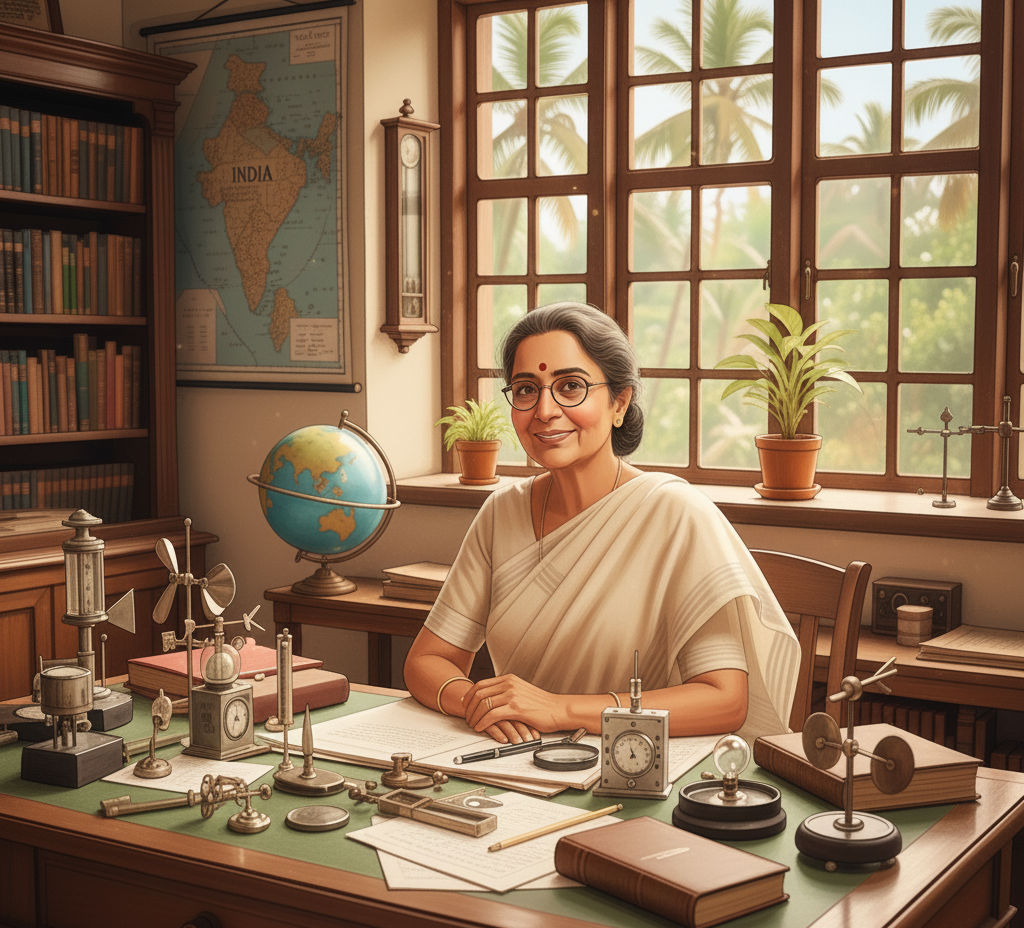

A young girl in a misty Kerala village, dreaming beyond the tea plantations. In 1918, when India was still under British
rule and women rarely touched science, Anna Mani picked up a book on physics instead of a cooking pot. Denied a PhD, denied easy resources, denied the spotlight—she built India’s weather forecasting empire from scratch.
Anna Mani, the “Weather Woman of India,” turned imported gadgets into homegrown tech that powers everything from cyclones warnings to wind farms today. Her story isn’t about genius alone; it’s about grit in freezing labs, ingenuity without degrees, and impact that outlives fame. If Anna could craft world-class instruments with her bare hands in post-independence chaos, what’s stopping you from building your breakthrough?
Roots in the Hills: A Spark in Peermedu
Anna Mani entered the world on August 23, 1918, in Peermedu, a highland hamlet in Travancore (now Kerala), seventh of nine children in a Syriac Christian family. Her father, a plantation manager, and mother valued education, but money
was tight—siblings shared textbooks, walking miles to school. Young Anna devoured chemistry sets and astronomy tales, fascinated by stars and storms raging over the Western Ghats. Medicine called first; she eyed doctorates. But physics gripped her at Maharaja’s College, Ernakulam, then Presidency College, Madras. Graduating with first-class honors in physics in 1940,
she ignored “suitable” paths like teaching. Physics promised puzzles: light, matter, energy. In an era of arranged marriages, Anna chose saris stained with chemicals over wedding silk. Her family supported, but society whispered doubts. Lesson one: roots don’t limit reach. From village trails to lab benches, Anna’s first step was bold—follow curiosity, even if it leads uphill. Her early fire? Spectroscopy—splitting light to reveal hidden gems. Diamonds and rubies weren’t jewelry; they were crystals hiding atomic secrets. This wasn’t hobby science; it was frontier work, aligning with global quests like quantum leaps.
C.V. Raman’s Lab: Freezing Nights, Burning Ambition
1940: Anna joined Nobel laureate C.V. Raman’s Rayleigh Memorial Physical Laboratory at the Indian Institute of Science
(IISc), Bengaluru. No fanfare; she was 22, one of few women amid beards and bowties. Tasks? Grind gems, chill them to
liquid air temps (-190°C), expose to lasers. Hands blistered, breath fogged—yet she produced five papers on ruby/diamond luminescence, absorption, and Raman spectra. Imagine: nights in sub-zero chambers, calibrating
spectrographs by candlelight during blackouts. Peers published; Anna’s name appeared too. But University of Madras
blocked her PhD—no master’s prerequisite. Rejection stung, yet fueled her. Raman praised her “tenacity”; she learned
independence fast.
World War II raged; imports halted. Anna improvised fixatives, mirrors from bottles. This phase forged her: science demands hands, not just heads. Motivation hit: doors slam? Build your own. By 1945, weather beckoned. Raman urged meteorology—India’s skies needed measuring. Post-war, Cavendish Lab (England) offered training. Anna sailed alone, defying travel bans for women. There, Imperial College and Kew Observatory taught radium standardization, barometers, hygrometers. No PhD, but skills sharper than degrees. Returning 1948, she was armed for India’s atmospheric revolution.
India Meteorological Department: From Clerk to Creator
Pune, 1948: India Meteorological Department (IMD) hired Anna as meteorological physicist. Chaos reigned—partition scattered staff, monsoons mocked forecasts with faulty foreign tools. Barometers burst in heat; rain gauges rusted. India imported 80% gear, bleeding forex. Anna’s mission: indigenize. She redesigned 120+ instruments: thermometers,
anemometers, pyrheliometers, sunshine recorders. Rain gauge? Standard cups missed slant drops; hers funneled
precisely, surviving cyclones. Barometers used Indian mercury, aneroids calibrated locally. Pyranometers—solar meters tracked panels without imports. Her team of 121 women/men churned prototypes in sweatshops, testing in Saharan
summers, Himalayan chills.
By 1950s, Pune’s Instrumentation Lab became self-reliant hub. Anna trekked mountains, exposing ozonesondes balloons
piercing ozone layers. Data plotted India’s first ozone maps, aiding WHO studies. She pioneered automatic weather
stations, precursors to radars. 1960s: Thumba Equatorial Rocket Launching Station (TERLS) needed profiles; Anna’s
balloons delivered, fueling Vikram Sarabhai’s space dreams. Challenges? Sexism: “Woman can’t climb towers.” She did, sari hitched. Budgets? Pennies; she scavenged WWII scrap. Politics? Transfers plotted; she outlasted. Rising to Deputy
Director-General (1976 retirement), Anna authored IMD handbooks, trained ASI nations. Her Wind Atlas (1980s)
pinpointed turbines, birthing India’s 50GW wind power. Pure grit: turn “impossible” into inventory.
Instruments That Changed India: Tech from Tenacity
Anna’s genius shone in details. Take the ozonesonde: chemical sensors on balloons measuring ozone up to 30km. Hers used potassium iodide, cheaper than imports, accurate to parts-per million. Global commissions adopted tweaks.
Pyranimeter: dome sensors gauging diffuse/direct solar. India’s tropical haze demanded recalibration; Anna’s version fed solar farms. Anemograph: wind speed recorders on drums, surviving 200km/h gusts. Sunshine recorder: bowls melting cards under focused rays, standardized for IMD’s 500 stations.
Solar radiation networks? She mapped insolation, proving Rajasthan’s deserts solar goldmines. Urban heat islands? Early papers warned Delhi’s concretization spiked temps 2°C. Post-retirement, Raman Research Institute saw her build 8mm radiometer telescopes, scanning clouds millimeter-wave. No patents chased; impact was legacy. IMD’s 99% local gear by 1970s? Anna’s blueprint. Cyclones Phailin, Hudhud—forecasts trace her gauges. Wind farms in Tamil Nadu, Gujarat? Her atlas. From village girl to sky-scanner, she measured monsoons, powered progress.
Battles Fought, Barriers Broken
Anna’s war wasn’t weather; it was worth. Women in IMD? Token. Labs unisex, no facilities. She petitioned toilets, won.
Marriage? Declined proposals; science was spouse. Stroke 1994 paralyzed half; she dictated papers from bed till 2001
death (Aug 16). No early awards—Padma bypassed, unlike men. INSA K.R. Ramanathan Medal (1987) late nod. PhD denial haunted; she proved “credentials optional.” Colonial hangover: “Brown woman, no Ivy?” Anna’s reply: results.
Isolation bit. Siblings scattered; Peermedu faded. Yet letters to Raman, Bose sustained. She mentored quietly—Kalpana
Chawla echoes? Not direct, but trail widened. Feminism avant: “Work proves gender irrelevant.” Trials teach: adversity alloys strength. Anna’s underdog arc mirrors yours—rejections, resource crunches. She flipped scripts: denied degree? Designed destiny.
Revival: From Footnotes to Forefront
Anna slipped textbooks post-1976. 2018 centenary exploded: Google Doodle, WMO tribute, “Anna Mani Gender Equity
Lecture” series. Books: Anna Mani: The Woman Who Measured India’s Skies (DownToEarth). Films, kids’ tales (Kiddle.co). Asteroid 3352 McAuliffe kin? No, but legacy orbits. Why resurgence? STEM diversity wave. spotlights her sans-PhD triumph amid IIT quotas. Climate crisis? Her ozone/solar data combats it. India@100: Chandrayaan nods roots like hers.
Bose Institute, IMD Pune bear plaques. Vigyan Prasar comics inspire Kerala kids. Global: ScientificWomen.net profiles her for girls worldwide.
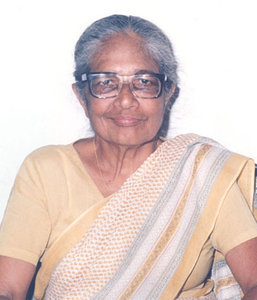
Anna in 2025: Skies She Shaped Still Shine
Today, IMD radars whirl on her standards; Aditya-L1 solar probe uses her radiation legacy. Climate models? Ozone data hers. Gujarat’s 10GW wind? Atlas-born.
Rise with the Woman Who Read the Winds
Anna Mani wasn’t born pioneer; she forged it. Village vistas to vertical ozone trails, she measured not just weather, but will.