
Disclaimer
The term “mental masturbation” is an informal slang expression used to describe patterns of excessive or self‑indulgent thinking that feel productive but do not lead to real‑world action or meaningful change. It is not a clinical or medical diagnosis, and it is not meant to shame or insult anyone. In this Blog, the term is used only as a descriptive and educational phrase to help readers recognize unhelpful thought habits such as overthinking, endless planning, or empty theorizing so they can replace them with practical, healthy actions and genuine personal growth.
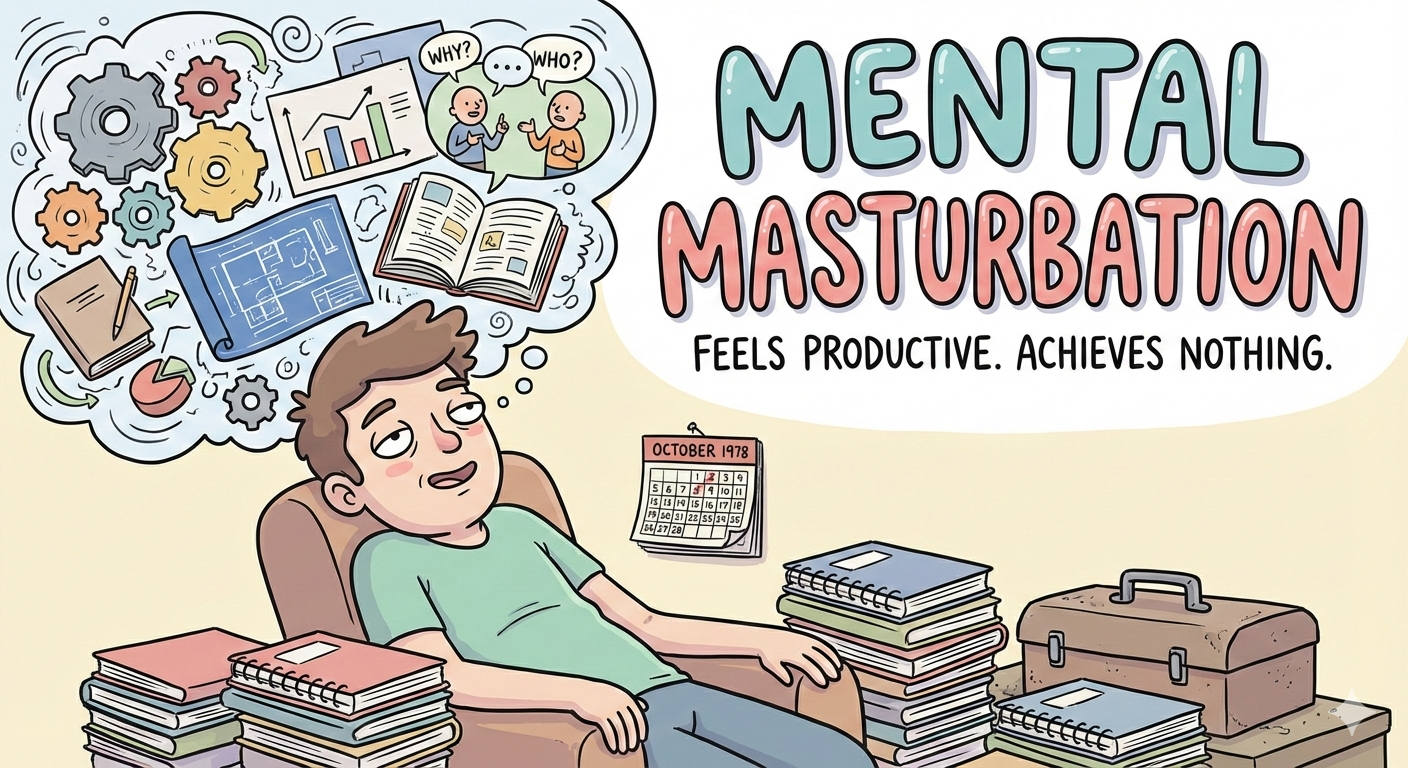
There are days when the mind feels busy from morning to night, yet nothing actually changes in life. Plans are made, ideas are discussed, videos are watched, but goals remain exactly where they were last year. This invisible trap has a name: mental masturbation.
What Is Mental Masturbation?
Mental masturbation is a slang term for self‑indulgent thinking that feels clever or satisfying but does not lead to any real world result. and It can look like;
- Endless planning without ever starting
- Debating ideas for hours that change nothing in your life
- Daydreaming about success without taking one practical step
In simple words: the brain is busy, but life is not moving.
Why People Fall Into This Trap
Most people do not waste time on purpose. Mental masturbation often begins with a genuine desire to improve life, but then thinking becomes a substitute for action. Common reasons:
1. Fear of failure: “If I just think a little more, I will find the perfect way and never fail.”
2.Ego satisfaction: the pleasure of feeling smart, deep, or different while doing nothing.
3.Escaping reality: thinking about a better future instead of facing uncomfortable truths today.
4.The result? A person feels exhausted and “mentally tired” but is no closer to their goals.
How Mental Masturbation Shows Up in Daily Life
1. Over planning and never starting
- Writing the “perfect” routine again and again, but never following it.
- Researching business ideas for months, comparing tools, watching tutorials, but never launching.
The brain enjoys the feeling of being busy and prepared, so it keeps planning instead of acting.
2. Consuming too much information
Information is good. Over consumption is not.
- Watching dozens of motivational videos without doing any of the suggested actions.
- Reading book summaries, threads, and posts on success, but not applying even one principle consistently.
Learning without implementation becomes another form of mental entertainment.
3. Endless “deep” conversations
Some discussions are useful. Others are just noise.
- Arguing for hours about politics, philosophy, spirituality, or success, yet nothing in one’s own habits changes.
- Using big words and complex ideas that sound impressive but have no connection to daily behaviour.
The mind feels powerful, but the bank account, health, and relationships remain unchanged.
4. Fantasy success in the head
- Imagining a future where you are rich, famous, fit, or respected, but not building the skills or routines required.
- Talking often about “one day I will…” without a date, plan, or deadline.
This fantasy gives a temporary high, like a mental drug, then drops you back into the same life.
The Hidden Costs of Mental Masturbation
Mental masturbation does more harm than just wasting time.
It kills urgency: when you constantly think, you start believing thought itself is progress.
It increases self‑doubt: years of thinking without results can make you feel “something is wrong” with you.
It damages confidence: every unfulfilled plan becomes proof that you cannot trust yourself.
Over time, people begin to say, “I know so much, but I don’t do anything.” That sentence is the perfect summary of mental masturbation.
Healthy Thinking vs Mental Masturbation
Not all thinking is bad. Deep reflection, planning, and learning are powerful when they lead to decisions and action. kindly, Use this simple filter:
Productive thinking: it has a clear goal, a time limit, and ends with a decision or next step.
Mental masturbation: it goes in circles, has no deadline, and leaves you exactly where you started.
Ask yourself: “After this hour of thinking, what will change in my behaviour today?”
How to Break the Cycle and Move Into Action
1. Set a time limit for thinking
Give your mind a boundary.
- 15–30 minutes to think, research, or plan.
- At the end of that time, force yourself to choose one small action.
For Example: I will research exercise routines for 20 minutes, then I will follow one 10‑minute workout video today.”
2. Decide the next physical step
Every useful thought must produce a physical action. like , Ask: “What can I do in the next 10 minutes that moves this forward?”
- If you thought about starting a blog: write one paragraph.
- If you thought about improving health: drink water and walk for 10 minutes.
- If you thought about saving money: track today’s expenses.
These Actions, even small, breaks the spell of endless thinking.
3. Limit information intake
Set a daily Routine:
- Only one article, one video, or one podcast, or One healthy habit on self improvement per day.
- After consuming, you must implement at least one idea before taking more content.
This activity trains your brain to connect knowledge with movement, not just mental pleasure.
4. Use “If‑Then” rules
Create simple rules that force action for yourself :
- “If I catch myself watching the third motivational video in a row, then I will close YouTube and work for 15 minutes.”
- “If I rewrite my plan again, then I will start with the first item immediately.”
These rules turn awareness into behaviour and will bring changes.
5. Measure actions, not ideas
Stop asking, “How much do I know?” Start asking, “What did I actually do this week?”
Track:
- Number of workouts, not fitness videos watched.
- Hours of deep work, not productivity tips learned.
What gets measured gets done.
Turning Your Mind From Entertainment to Engine
The mind is a powerful machine. Used wrongly, it becomes a cinema hall, playing beautiful movies that never leave the screen. Used rightly, it becomes an engine, pulling your life forward. To shift from mental masturbation to meaningful thinking:
- Think with purpose.
- Decide with courage.
- Act with discipline.
Every time you feel that pleasant buzz of “I’m thinking so deeply,” gently ask: “What will I do about this today?” The moment thought ends in action, the game changes. Life stops being a theory and starts becoming a result.
*