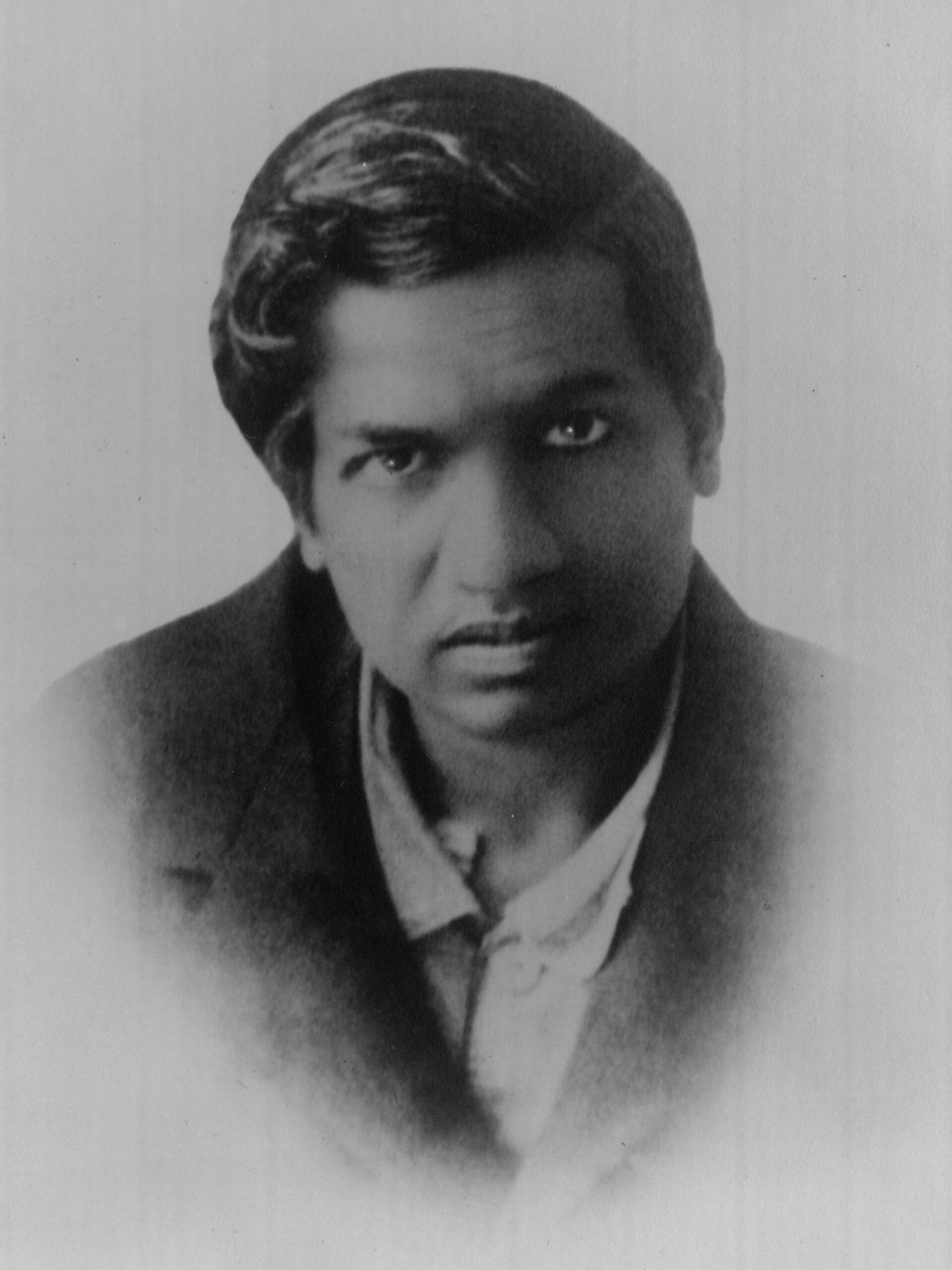

Srinivasa Ramanujan’s life reads like a miracle of human potential: a poor, largely self taught boy from South India
whose notebooks stunned the finest mathematicians of Cambridge and changed modern mathematics forever.
His story is not just about formulas, it is about passion, courage, and the power of believing in your gift even when the
world does not understand you.
Humble beginnings in Kumbakonam
Srinivasa Ramanujan was born on 22 December 1887 in Erode, Tamil Nadu, into a poor Brahmin family; his father worked as a clerk, and his mother was a homemaker deeply involved in temple traditions. When he was still a small child, the
family moved to Kumbakonam, a temple town whose culture and schools quietly shaped his early mind.
In school, Ramanujan was not a “perfect” student; he was extraordinary in mathematics but often neglected other
subjects. By the age of 13, he had mastered trigonometry from advanced books and began deriving his own results,
solving complex problems that many college students struggled with. Teachers quickly realised he was not just
bright he was exceptional, yet his obsession with maths started to cost him marks in other areas.
Discovering his universe in a single book
At 16, Ramanujan found a book that changed his life, George Shoobridge Carr’s “Synopsis of Elementary Results in Pure and Applied Mathematics. This book was basically a list of thousands of theorems and results with very little explanation, a compressed summary of years of mathematical knowledge.
Most students would be overwhelmed, but Ramanujan treated this synopsis as his universe, he didn’t just memories results, he worked to re-derive and extend them, filling notebooks with proofs, new formulas, and bold conjectures. He had no formal mentor, no access to a modern library, yet his mind refused to stay small, this is where his genius began to explode quietly in the background.
Failure, poverty, and unshaken passion
Despite his brilliance, Ramanujan’s academic journey was full of setbacks. He won scholarships to study at institutions like Government College, Kumbakonam, but repeatedly failed formal exams because he ignored subjects other than
mathematics.
Without a Fellow of Arts degree, the normal path to a secure career closed, and he found himself living in severe poverty, sometimes near starvation, while continuing his private mathematical research. He took up small clerical jobs and tutored students, but his health and finances were fragile, and yet he never stopped thinking about numbers.
In the margins of life between illness and odd jobs he kept producing magic in the form of
formulas written in worn out notebooks, driven only by inner curiosity and a sense that his work mattered.
This phase of his life is profoundly inspirational: he had no guarantees, no big degrees, no promise of fame. All he had was conviction and work.
Recognition in Madras: the first doors open
In 1910, a turning point came when Ramanujan met V. Ramaswamy Aiyer, founder of the Indian Mathematical Society,
who was deeply impressed by the young man’s raw talent. Mr. Aiyer and others in Madras (Chennai), including mathematician R. Ramachandra Rao and professors at Presidency College and the University of Madras, began to support him financially and intellectually so that he could focus more on his research.
The University of Madras granted him a research scholarship, which allowed Ramanujan to spend time purely on
mathematics instead of constantly worrying about survival. Still, his work needed a wider audience; his ideas were so
advanced that very few people locally could truly judge their depth.
The legendary letter to G. H. Hardy
In January 1913, from his small world in Madras, Ramanujan took a daring step: he sent a long letter filled with around 120
mathematical formulas to G. H. Hardy, a leading British mathematician at the University of Cambridge. The letter contained startling results in number theory, infinite series, and continued fractions, many without proofs, written in
Ramanujan’s distinctive, compact style.
At first, Hardy suspected a hoax, he had never seen anything like it but after carefully checking the formulas with his
colleague J. E. Littlewood, he concluded that Ramanujan was “a mathematician of the highest quality, a man of altogether exceptional originality and power.
Hardy later called it the most remarkable letter he had ever received. From a clerk’s desk in Madras to the desks of Cambridge’s finest mathematicians, Ramanujan’s work had finally found the light. This is one of the greatest stories of hidden talent being recognised because he dared to show his work to the world.
Journey to Cambridge: two worlds meet
With support from British and Indian scholars, Ramanujan was invited to Cambridge and reached England in 1914, in the
middle of World War I. Coming from a strict vegetarian Brahmin background, he struggled with food, climate, and
cultural differences, yet his mind continued to soar in the world of mathematics.
In Cambridge, Ramanujan worked closely with Hardy and Littlewood, a collaboration that blended Ramanujan’s intuition
and Hardy’s rigorous methods. Hardy admired Ramanujan’s genius but also tried to introduce him to formal mathematical proof, while Ramanujan astonished his colleagues by producing new results at an extraordinary pace. Their partnership produced deep theorems in number theory, partitions, and infinite series that still influence
mathematics today.
Brilliant contributions: far ahead of his time
Ramanujan’s work covered several advanced areas, especially number theory, infinite series, continued fractions, and modular forms.
Some of his notable contributions include:-
Partition function: With Hardy, he developed an asymptotic formula to estimate the partition function 𝑝(𝑛), which counts the number of ways a positive integer can be expressed as a sum of positive integers. This was a breakthrough in understanding the behaviour of partitions for large numbers.
Highly composite numbers: His Cambridge degree in 1916 was awarded for his work on highly composite numbers, where he studied numbers with more divisors than any smaller number.
Mock theta functions: In his last letters and notebooks, he introduced mysterious functions he called “mock theta
functions,” which puzzled mathematicians for decades and later became a central topic in modern number theory and
modular forms.
Infinite series and continued fractions: He produced remarkable formulas for(𝜋) infinite series, and continued
fractions that were incredibly efficient and elegant. Many of these ideas were so advanced that their full
importance was only understood long after his death. mathematicians continue to study and extend Ramanujan’s
work, finding applications even in modern physics and string theory.
Honours in a short life
Despite his unusual background and lack of traditional degrees, Ramanujan quickly gained recognition in Britain’s mathematical community. He was elected to the London Mathematical Society in 1917, a major honour during his time at Cambridge.
In 1918, he was elected a Fellow of the Royal Society (FRS) for his investigations in elliptic functions and number theory,
becoming only the second Indian and one of the youngest people ever elected at age 31. Later that year, he also became the first Indian Fellow of Trinity College, Cambridge.
From a small house in Kumbakonam to the highest scientific circles of Britain, Ramanujan’s rise shows how true talent can cross all barriers of race, class, and geography when given a chance.
Illness, struggle, and early death
Behind the honours, Ramanujan’s health was fragile. During his time in England, he suffered from poor nutrition, harsh climate, and possibly underlying medical conditions, including tuberculosis and complications from intestinal infections.
He fell seriously ill around 1917 and spent long periods in sanatoriums, yet he still continued to do mathematics, filling
notebooks even from his sickbed. In 1919, as his health slightly improved, he returned to India, but the recovery was
temporary; he died on 26 April 1920 in Madras at the age of just 32.
Medical historians believe a combination of tuberculosis, malnutrition, and possibly amoebiasis related complications
contributed to his death. His life was tragically short, yet the intensity of his contribution in those few years remains
unmatched.
The final notebooks and a legacy that keeps growing
In the last year of his life, even while extremely weak, Ramanujan wrote to Hardy describing his new discovery of
“mock theta functions,” leaving behind a final notebook full of mysterious formulas. For decades, these functions
puzzled experts, and only in the late 20th and early 21st century did mathematicians fully understand that Ramanujan
had anticipated deep structures in the theory of modular forms and q-series.
Today, his notebooks, letters, and formulas are still being studied, new research papers continue to emerge from seeds
he planted more than a century ago. His name appears in theorems, the Ramanujan Journal (a scientific journal dedicated to his areas of work), and in countless books that celebrate both his mathematics and his story.
Why Ramanujan’s story is so inspiring
Ramanujan’s life offers several powerful lessons:-
Genius can come from anywhere: He was born far from the major centres of learning, with limited resources, yet his
work reached and transformed the world’s top university.
Passion survives hardship: Poverty, exam failures, illness none of these stopped his love for mathematics. When
external doors closed, he kept building his own inner universe of ideas.
The importance of mentors and allies: Without people like V. Ramaswamy Aiyer, Ramachandra Rao, and Hardy, much of his work might have remained in obscurity. Support and recognition can change a gifted life forever.
Intuition and rigour together create magic: Ramanujan’s intuitive leaps combined with Hardy’s formal rigour produced
results that neither might have created alone. His journey is a reminder: even if your path is unconventional, your school record imperfect, or your resources limited, your true calling can still shine if you stay committed, seek help
when needed, and dare to share your work.
Ramanujan as a symbol of possibility
India celebrates his birthday, 22 December, as National Mathematics Day, honouring his contribution and inspiring new
generations to see mathematics not as fear, but as beauty. Across the world, students encounter his formulas, learn
about his collaboration with Hardy, and see in him a symbol of the human mind’s potential.
Srinivasa Ramanujan’s story is not just about numbers; it is about a young man who held on to his gift with fierce devotion, despite hunger, failure, and illness. He proves that a single determined mind, even in difficult conditions, can leave a mark so deep that the world is still trying to fully understand it a hundred years later.