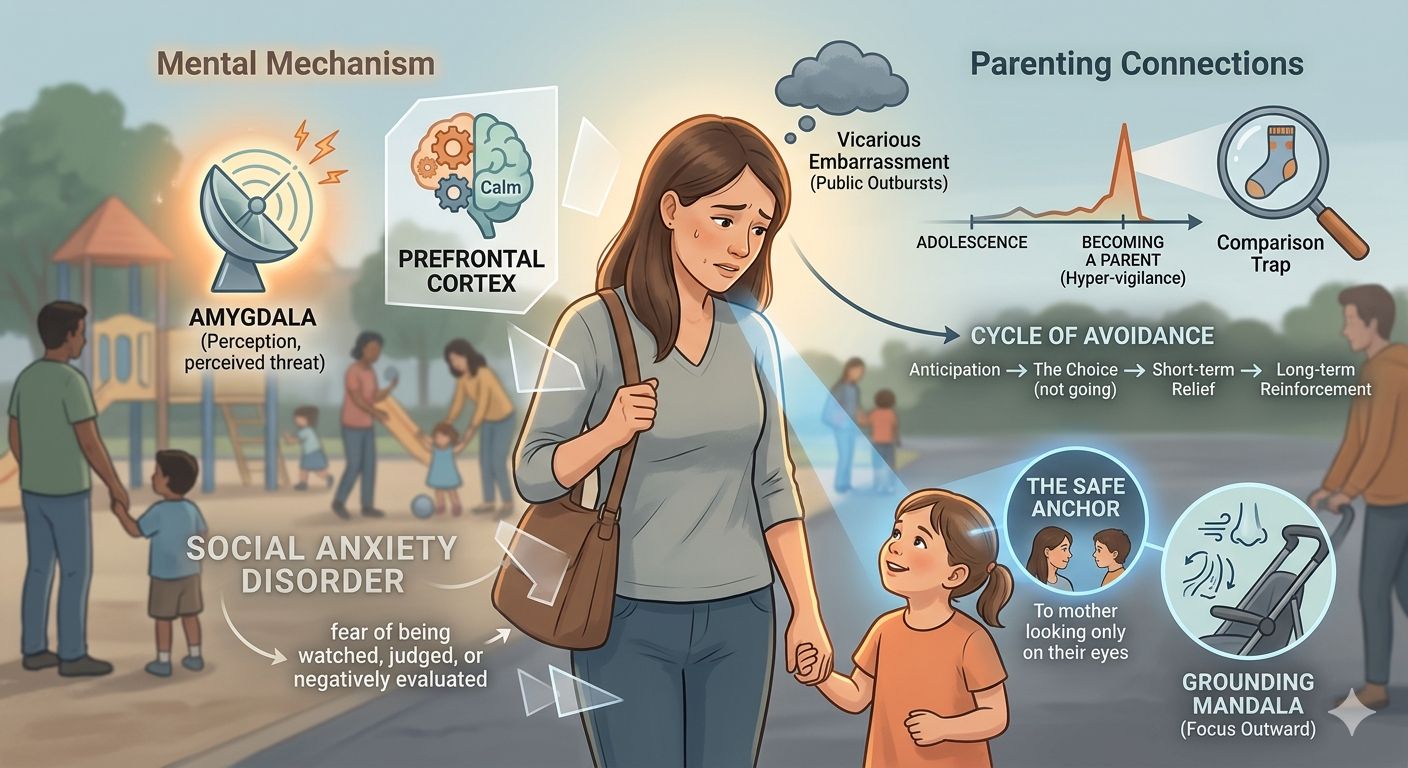
Social anxiety is essentially a “malfunction” of the brain’s survival instinct. Instead of protecting you from physical danger, it treats social judgment as a threat to your safety. When you are a parent, this “threat” feels even larger because you aren’t just protecting your own image you are protecting your child’s.
1. The Core Mechanics: What is Happening?
At its center, social anxiety is Hyper-Vigilance. Your brain is constantly scanning the environment for signs of disapproval.
- The Internal Critic: You become a harsh judge of your own words. While talking, you are simultaneously “watching” yourself and assuming you look awkward or sound “off.”
- The Spotlight Effect: You overestimate how much people notice you. You might think everyone is looking at your child’s mismatched socks, when in reality, they are likely worrying about their own lives.
2. The Parenting Connection: “The Greenhouse Effect”
Parenting acts like a greenhouse for social anxiety, it makes it grow faster because of three specific pressures:
- Vicarious Embarrassment: When your child is loud or messy in public, your brain signals that you have failed. The child’s behavior is felt as a direct reflection of your character.
- The “New Social World”: Parenting forces you into social “forced-interactions” you can’t easily avoid:
- School gates and teacher conferences.
- Doctor visits and health check-ups.
- Playdates with parents you might not naturally click with.
- The Comparison Trap: Seeing “perfect” families at the park or on social media reinforces the fear that you are being negatively evaluated by other parents.
3. When and Where: The Trigger Points
For a parent, social anxiety isn’t constant; it usually spikes in these specific “Whens”:
| Situation | The Internal Fear |
| The School Run | “Do the other parents think I’m distant or weird because I don’t talk much?” |
| Public Tantrums | “Everyone thinks I have no control over my child. They think I’m a bad parent.” |
| Medical Check-ups | “Is the doctor judging my child’s progress or my lifestyle choices?” |
| Formal Events | “Can I keep my child quiet and well-behaved enough to not be noticed?” |
4. The Impact on the Child
If left unmanaged, social anxiety can change how you care for your child:
- Narrowing their World: You might subconsciously avoid taking them to busy parks or birthday parties to keep your own anxiety low.
- Emotional Mirroring: Children are highly sensitive. If they see you tensing up every time a neighbor approaches, they may learn that “strangers = stress.”
5. Practical Strategies for “The Moment”
To manage this while parenting, try the “Focus Outward” method:
- Prioritize the Child, Not the Crowd: When anxiety hits, stop looking at the people around you. Look only at your child. Focus on their needs (a hug, a distraction, a snack). This “tunnels” your vision away from the imaginary judges.
- Accept the Mess: Remind yourself: “Children are allowed to be children in public.” A loud child is not a sign of a bad parent; it’s a sign of a growing human.
- The “Safety” Script: Prepare three standard sentences for small talk (e.g., “The weather has been so unpredictable lately, hasn’t it?”). Having a script reduces the “mind-blanking” that happens during anxiety.
The Neuroplasticity Factor (The 21-Day Habit)
- The Rewire: Just as it takes roughly 21 days to form a new habit, it takes consistent “micro-exposures” to shrink the brain’s fear center (the amygdala).
- The Action: By choosing one small, uncomfortable social action each day for three weeks—such as a brief greeting to a neighbor or asking a clerk a question—the brain slowly replaces the “threat” signal with a “safety” signal.
The “Safe Anchor” Strategy
In parenting, the child can inadvertently become a source of social stress, but they can also be the solution.
- The Concept: When the feeling of being watched by other adults becomes overwhelming, shift your entire focus onto your child’s world.
- The Action: Dive into “Deep Quality Time” in the middle of the crowd. Narrate a story to them, play a quiet game, or focus on their eye level. By making your child your “Safe Anchor,” you create a private bubble that naturally tunes out the “background noise” of the audience.
Physical Posture & The “Armor” Effect
There is a direct link between physical presence and mental confidence.
- The Concept: Anxiety causes a “collapse” in posture—shoulders rolling forward and eyes downcast—which tells the brain you are in danger.
- The Action: Use your physical discipline as armor. Maintaining an open, upright posture (shoulders back, chin level) even when you feel nervous physically lowers cortisol levels. When you look “solid” for your child, your brain starts to believe that you are solid.
Reducing “Comparison Noise”
Social anxiety is often fueled by the digital world before you even leave your house.
- The Concept: “Digital Peace” is a prerequisite for social calm. Scrolling through “perfectly curated” parenting content or high-achievement feeds before a social outing sets a baseline of “not being good enough.”
- The Action: Implement a Digital Fast for two hours before any social event. This protects your headspace from comparison, allowing you to enter the situation grounded in your own reality rather than someone else’s highlight reel.
Creative Externalization
For the creative mind, anxiety is simply unprocessed energy.
- The Concept: Instead of fighting the feeling, observe it as a third-party observer.
- The Action: Treat a social anxiety spike like a cinematic scene or a complex musical texture. By mentally describing the situation (“The room is loud, the light is harsh, my heart is at 100bpm”), you move the experience from your emotional brain to your analytical brain. This distance makes it much easier to stay present as a parent.